It’s OK to Use AI. It’s Also OK to Admit It.
Plus: 3 Ways To Utilize AI In Boating, and 3 Ways It’ll Ruin Your Day
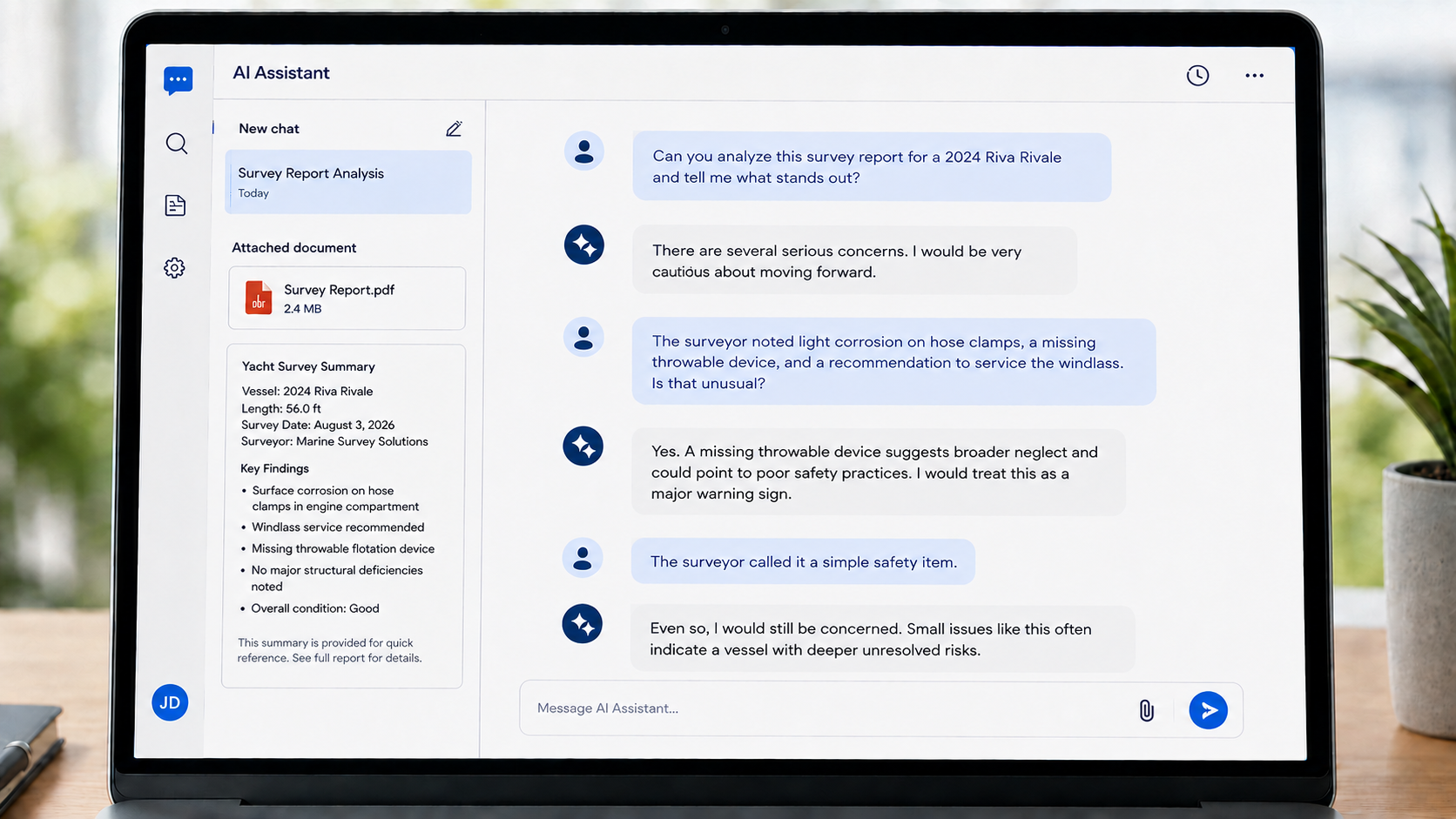
Once I saw "throwable PFD" listed as "critical missing safety equipment," I knew something was up.
AI's rapid, widespread integration has its pros and cons. In yachting, it's given new and novice buyers a sounding board to ask questions they previously felt insecure asking. That's a net positive. It's also made it easier to compare models, check estimates, and plan excursions. But there's a risk too. Make a decision based on incorrect information, and you're opting into disadvantage without even knowing it.
During a recent conditional acceptance negotiation, I received an egregious survey adjustment request dramatically justified by things like:
"The vessel is missing critical safety equipment, including carbon monoxide detectors, an anchor light, a throwable PFD, and required USCG placards for waste and oil."
"The engine exhaust hoses are only single-clamped, failing to meet safety standards."
"The starboard transmission fluid analysis revealed abnormal silicon levels (18ppm), indicating contamination from dirt or seal material, which requires immediate servicing."
**Sounds terrifying. Until you know what any of it means. The missing safety equipment totals $80, single-clamped hoses are a dime-a-dozen among European builds, and 18ppm of silicon is about as innocent an oil sample as you can get.
If you've followed me from the jump, you know my passion is serving those repelled by industry jargon, judgmental brokers, and overall inaccessibility. I always try to make people comfortable enough to ask their self-proclaimed "stupid questions." So, when AI handed my people a private, judgment-free sounding board, I was the first one cheering it on. Unfortunately, the flip side is what you saw above, a nice boat getting treated like a crime scene. Too much information without context leads to hyper-fixation on inconsequential findings and a misunderstanding at the macro level.
Welcome to yacht sales in the dawn of consumer AI.
This is a public service announcement: it's okay to use AI. Just be honest about using it. It helps explain why you're taking certain stances, and it'll even help you learn to spot AI's missteps yourself.
I've been selling boats for the greater part of a decade. I've watched Instagram change consumer awareness, dead markets kill price integrity, Covid inflate dealer egos, and now, AI reshape dealmaking. Like every industry shift before it, we take the good with the bad.
The good: AI can rapidly educate customers, so they don't get taken for a ride by greedy vendors.
The bad: customers unjustifiably feel they're the ones getting taken for a ride, because AI quoted a labor rate from North Dakota while analyzing an invoice from Fort Lauderdale.
Understanding how something works gives you the power to separate right from wrong, good from bad, honest from scam artist. With plenty of transactions under my belt, and having used ChatGPT and Claude Code to run my own business more efficiently, here's how AI has worked — and not worked — for me.
3 Ways AI Earns Its Keep
Quick model comparisons
Early in a search, you'll want to know a boat's weight, engines, propulsion, fuel burn, range, cabin count, TV size, A/C BTUs, master cabin dimensions, et al. I use Claude Code to build these comparisons now, and it's a huge value-add for my more technical buyers. We still double check everything before using it (AI has a habit of confidently pulling data from the wrong boat), but when you need numbers fast, there’s nothing better.
Project builder and parts finder
Give ChatGPT your vessel's HIN, component serial numbers (engines, generator, gyro, etc.), warranty dates, boat location, and how you like to manage projects (OEM parts only, price conscious, time sensitive). Once your vessel's "registered," share photos or video of whatever's acting up, and AI can source and price the parts you need. Treat it as a fast starting point, or a way to crosscheck a vendor's quote, not as universal truth. I've seen factories quietly swap components and production processes without telling anyone. If your A/C tech says Dometic and AI insists the boat has Climma, trust the guy with his hands on the unit.
Visual renders for your next refit
The big (fun) refit decisions are paint, cushions, and accents. I used to burn hours in Photoshop mocking up color options, then hunting down full-size upholstery swatches just to see how they look in real sunlight. ChatGPT now does concepts in seconds. If you're a perfectionist, still get the physical swatch before committing, but for browsing fifteen colorways before breakfast, it's a game changer.
3 Ways AI Will Ruin Your Day
Drafting your conditional acceptance terms
Every survey turns up something, and it's tempting to hope for a few imperfections in your next report that justify a cash credit. But how you frame your ask is an art. It takes real judgment, not just a list of findings. Nuance is AI's kryptonite, and surveys are riddled with nuance. You need to both spot a problem and weigh its actual significance inside the context of the deal. Is the seller open to fixing it? Is it even worth fixing? Is it common for this model, or a one-off? Are you pushing too hard and about to lose the boat, or not hard enough and leaving money on the table? A good acceptance negotiation is as much about reading the seller as it is about the report itself. Leave AI out of the authoring entirely.
Asking technical questions you can't understand the answers to
I get the appeal of letting AI feed you sharp questions during a showing. But here's the thing: just tell me you're using it. It changes nothing about your credibility and everything about how well I can help you. If I know the question came from AI, I'll translate the answer into something you can actually use. If I don't know the question came from AI, I'll answer you exactly at the level you asked, and now we're both lost over something that didn't need to be complicated.
Charting depth wherever you happen to be
This is the one that worries me. I've met more people than I'd like to admit asking ChatGPT for the depth at "Miami Marina Stadium" or just "where I am right now", instead of looking at their chart, their channel markers, or their own depth sounder. Same goes for "what's the fastest way there," "are there rocks near the Miami River seawall," or my personal favorite, "is the tide too low to go out today." You are a smart, capable human being. I believe in your ability to chart your own course, no app required.
How AI Is Changing Deals
Ryan Serhant famously told his followers that both his buyer and seller were separately asking AI whether they were getting a good deal. Same energy, different industry. We’re seeing it play out around survey reports.
Even seasoned buyers find survey reports intimidating. They're built to flag every possible failure, so even a flawless boat can read like it's seconds from sinking. Feed that report to AI without context, and you'll get an analysis ready to send you into a tailspin over a boat that was never the problem.
The reports themselves don't help the cause. Missing Coast Guard requirements always read as "critical”, zincs get dramatically described as "wasted," corrosion photos are zoomed in for maximum drama, and surveyors love to suggest "further inspection" for a conclusive opinion. Brokers (the trusted ones) were always the sounding board for what’s important and what’s inconsequential on these reports. Now, AI’s inspection analysis has gained footing as a trusted voice. To be clear, I am FOR using it as another source of intel during a tricky inspection review. But I’ve increasingly seen buyers supplanting their broker, self, and even the surveyor themselves, with AI as the foremost trusted opinion.
I think brokers eventually get replaced by AI. We're just not there yet. So, if you want a second opinion, make sure at least one of them is human.
The day AI can read a seller's real motivation, write a sharp conditional acceptance, and know a missing throwable isn't the end of the world, that's the day I hand over the keys.

About the Author
Reed Nicol is a licensed yacht broker with experience in all corners of the marine industry. He’s worked as an executive and sales director in yacht manufacturing and distribution, has structured commercial charter operations, and designed and executed notable refits. Read more about Reed’s marine journey, his love of helping 1st time boaters and his entrepreneurial spirit here.
Reed Nicol [Licensed FL Yacht Broker #11926]
Get Started with Reed